

 Share on bsky
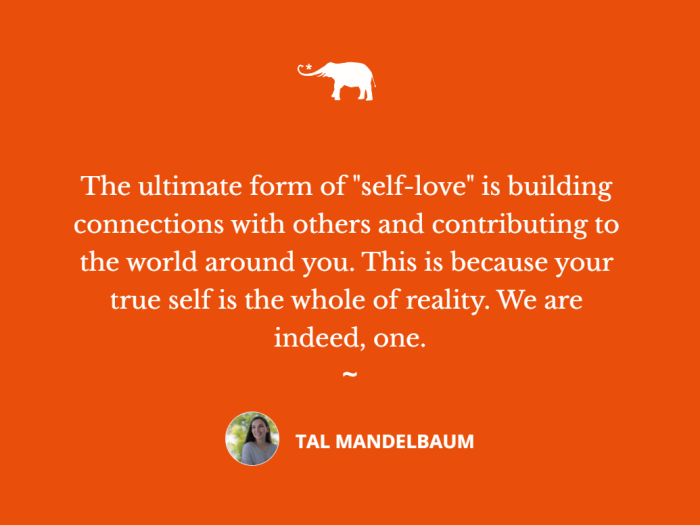
My spiritual awakening began in my early twenties, parallel to my university studies in psychology and political science. At that time, I enjoyed different self-help books that taught me that the most crucial thing standing between me and true happiness is “self-love”.
I was guided to feel that if only I would learn how to deeply love and accept myself, I would be full, happy, and content.
This seemed like a worthy goal, however, my soul led me to search deeper. A few years later, I was telling my Vipassana instructor, a wise teacher from a monastery in Thailand about ALL the different books I had been reading. Surprisingly, he scolded me! He told me that I had to “go to the source”. He said I needed to find my path in either the Buddha’s book or…the Bible.
The Bible?! I thought. Growing up Jewish I was always taught the Biblical stories. I had to memorize them in high school, but they were never more than literary or historical works. I had no clue how this book could lead me to enlightenment, to practical spiritual transformation.
It took me a couple more years to discover what my wise Vipassana teacher meant. I discovered that within the ancient Jewish texts was indeed a spiritual method called “Kabbalah”. Its purpose is to allow one to experience enlightened, unity consciousness, whilst in the physical body. In Kabbalistic words, “to discover the Creator in this life”.
One of the key things that Kabbalah taught me was that our default consciousness is centered on the self, which is the source of our suffering and limitations in time and space. As someone with a background in psychology, I found this notion to be logical.
Evidence from Science
Cognitive Psychology has suggested that we are surrounded by a sea of stimuli that is too overwhelming to process, and we have an internal filter mechanism that ensures we only perceive that which is relevant to our personal survival and well-being.
You may not be aware of this internal mechanism, but if you work to grow your awareness, you will come to see it. Interestingly, the way to grow our awareness of our self-focused inclination is to do our best to focus on others.
You can try this at home! Try to think about the well-being of other people, who do not directly belong to you, for one day (even for one hour). Very quickly you will see that this is quite impossible.
The ancient sages call this constant focus and concern for ourselves “self-love”. To them, it has a very different connotation. To them, this self-absorption is the reason for our suffering.
Ancient wisdom also calls our internal mechanism “the ego”. By filtering out everything that is not directly relevant to us, it cuts us off from the whole of reality. Within it, we are constantly in competition with others, comparing ourselves and feeling either good or bad about ourselves in the context of societal and cultural standards and expectations. We are in fact a slave to what other people think of us!
Oh, and even if you think that you “hate” yourself, or that you have destructive tendencies, and negative thoughts about yourself — it’s all still part of this mechanism that puts your focus on YOU. If you were completely focused on others, and their well-being, these negative thoughts would disappear too.
There is further research that backs this up.
A lot of psychological research has pointed to the notion that a focus on the self and a disconnect from others, plays a role in depression. One study that was done on the way depressed people use language, has shown that depressed people significantly use more first-person, singular pronouns (such as “me”, “myself” and “I”) and significantly fewer second and third-person pronouns (such as “they”, “them” or “she”).
Researchers have reported that these pronouns are actually more reliable in identifying depression than negative emotion words.
This is just one study of many, that shows how focusing on the self can trap us in negative emotional states, which explains why the teachings to be happy on your own, or to simply love yourself more, can be misleading.
We think that we can bypass our negative self-talk and feelings by somehow teaching ourselves to love ourselves just as we are, but this is not the best way. We are all connected, and we will always be vulnerable to the opinions of society and other people of us. We will always find ourselves fighting the comparison trap and endlessly striving for this sought-after “self-love”.
Unless we do something radically different.
The Consciousness Shift
The ancient sages tell us that the antidote to the suffering caused by our ego, our self-focused mechanism, is to learn how to escape it, by focusing on what is outside of us. This means, learning how to love other people. They tell us that this is true freedom and the true state of “paradise”.
It might sound counterintuitive because we are so wanting to feel love within ourselves. But ultimately, it’s when we learn how to love others at least as much as we love (care about and focus on) ourselves, we become free from the mechanism that shuts us off from the whole of reality. We expand our ability to perceive because we no longer filter reality according to what is relevant to us alone.
When we learn how to connect with what is outside of us, we connect to Love, oneness, to the infinite field of energy all around us. Ultimately, we become a channel of life energy for other people, and that energy, as it passes through you, fulfills you in a way your ego never could!
So do we need MORE self-love in order to be happy? No, we actually need less. What we need more of is self-transcendence.
This is the secret.
It is interesting to note that in his later years, Abraham Maslow added an additional level to his pyramid of human development. It came to him, that the pinnacle of our lives is not self-realization, but rather self-transcendence. He understood what ancient wisdom had been saying for millennia.
How to Feel Really Good About Yourself
Lastly, I would like you to consider this.
We human beings, can’t really see ourselves clearly on our current level of consciousness. We don’t really know who we are. We have a sense of self that is based on what is mirrored to us from the outside. As long as our current, ego-driven society is our mirror, this sense of self is mostly distorted. This is why we feel so in need of inner healing.
We need a new way to measure ourselves that comes from a higher perspective. The way to see yourself correctly is through the eyes of Nature itself. Nature is the living system of which we are all part. It is not just the plants and animals, but also the higher power that governs us.
From this higher perspective, everything is created with a purpose, including you. Just like every other part of Nature, you have a higher purpose, and nothing about you is random, or coincidental.
Of course, that doesn’t mean you don’t need to grow. You DO! You have to discover why you were created the way you are, and what gifts and attributes you have that need to be aligned, mastered, and used in the correct way in order to share with the world.
Yet, from this higher perspective, you can see that you are divinely created, and are therefore perfect just as you are. Everything about you is as accurate as the cells and organs of the human body that function in miraculous harmony and purposefulness.
Not only that, but there is no one quite like you and no one that can replace you and your role. You are uniquely important and valuable to all human beings and to all of Nature.
However, you will only truly discover this role, when you set out to connect and serve everyone and everything else that you are connected to.
This is the wisdom that the ancient sages offer us. If you want to be happy, learn how to connect to what is outside of you and care for it. This will set you free. This will help you see yourself as you truly are. This is how to actually feel the love that your heart longs for deep inside.
 Leave a Thoughtful Comment





Read 0 comments and reply